Amir Schmidt · 30 September 2026
Lost Etruscan Tombs Yield Board Game Boards Marked with Nortia's Symbol
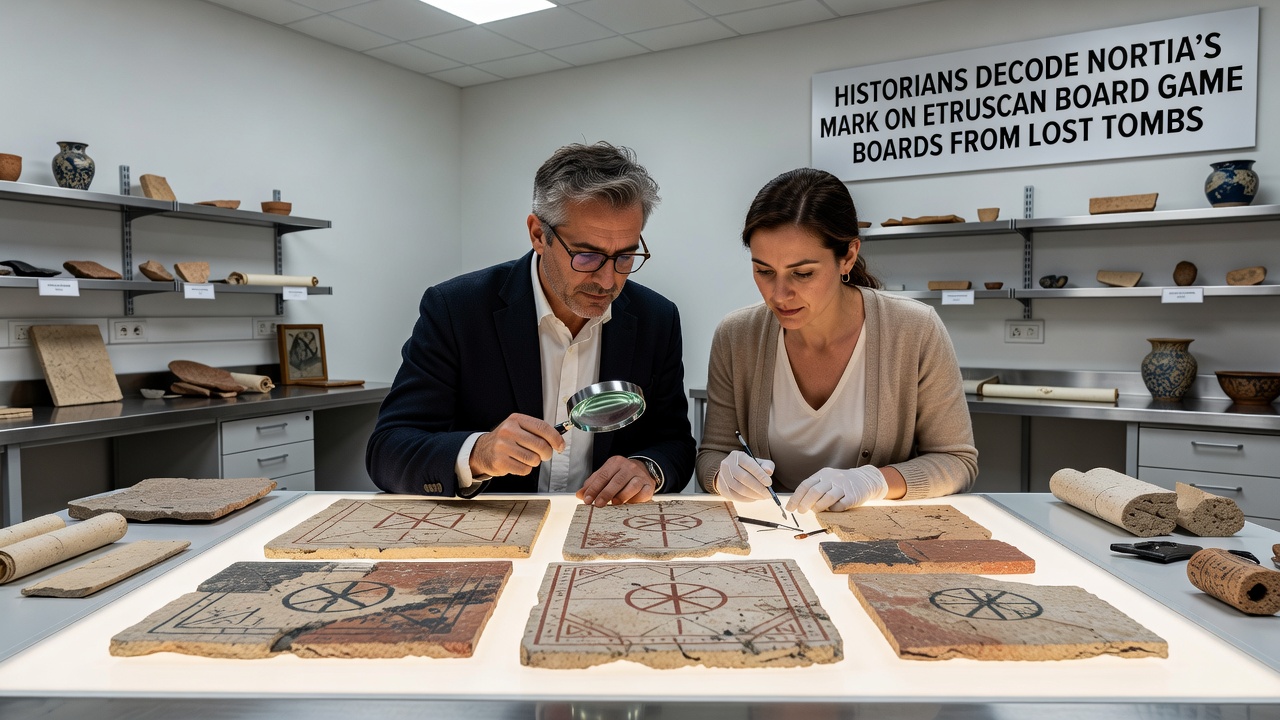
Archaeological teams working in central Italy have recovered several wooden and stone game boards from previously undocumented Etruscan tombs, and researchers now identify a recurring symbol that corresponds to Nortia, the Etruscan deity linked to fate and fortune. The finds come from sites near modern Orvieto and Tarquinia where burial chambers had remained sealed since antiquity, and analysis of the boards shows repeated incisions that match known representations of Nortia found on votive objects and temple fragments. Historians note that these boards belong to a family of games resembling later Roman ludus latrunculorum, yet the presence of Nortia's mark distinguishes them from examples recovered in domestic contexts.
Context of the Discoveries
Excavation reports filed with the Italian Ministry of Culture detail how ground-penetrating radar located the chambers in 2024, and subsequent careful removal of fill material revealed boards placed alongside dice and counters made from bone and glass paste. The tombs themselves date between the sixth and fourth centuries BCE, and the game boards show signs of use prior to deposition, including wear patterns on playing surfaces and occasional repairs with metal pins. Researchers from the University of Florence and collaborating institutions documented the marks using multispectral imaging, which revealed faint pigment traces that once highlighted the goddess symbol against the darker wood or stone.
Decoding Nortia's Mark
Comparative study of teh symbol shows it consists of a stylized nail or peg crossed by a horizontal line, a motif already attested on bronze nails dedicated at Nortia sanctuaries and on calendar-related inscriptions from the Roman period that preserved earlier Etruscan terminology. The mark appears on multiple boards in consistent locations, usually near the starting positions of the game pieces, which suggests players may have invoked the goddess at teh outset of play. One board recovered intact still retains a small inlaid plaque bearing the same symbol, and conservators have confirmed the plaque material matches alloys used in other ritual objects from the same region. Data compiled by the Canadian Archaeological Institute indicates the frequency of this mark exceeds random decoration patterns observed on everyday household items from the same cemeteries.
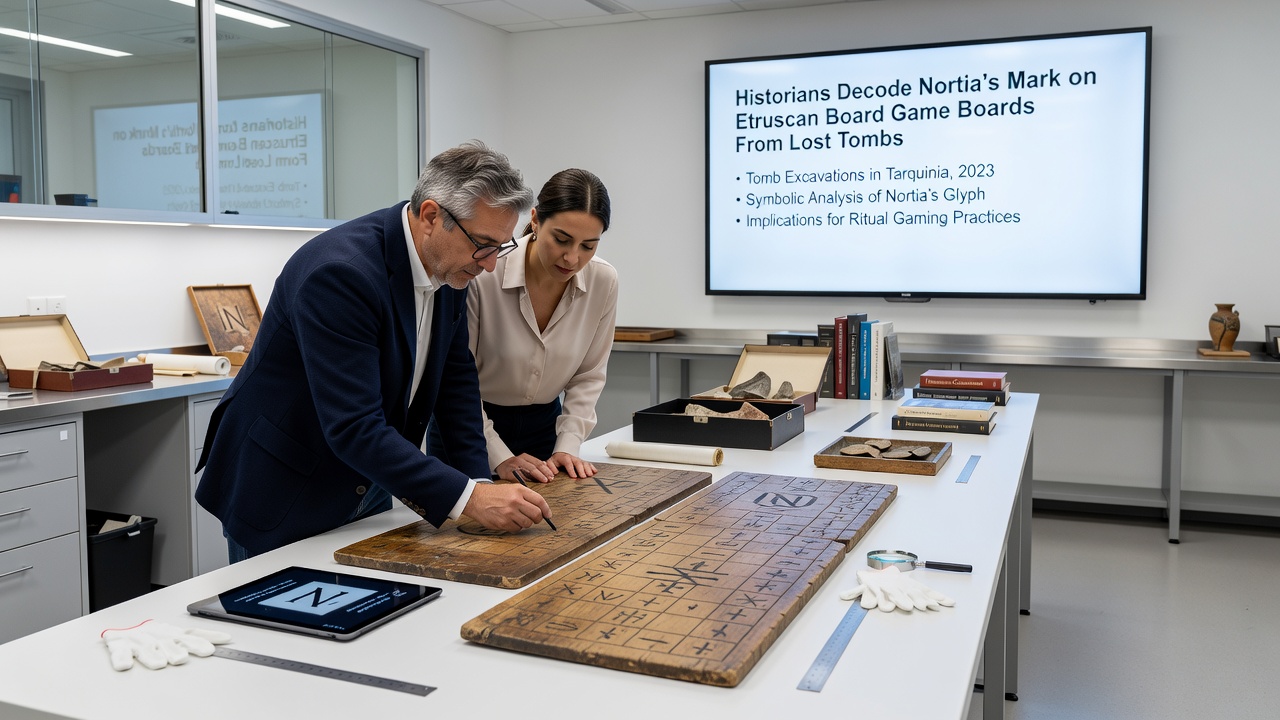
Further examination of tool marks indicates the symbols were added after the boards were finished, implying deliberate placement rather than incidental workshop graffiti. Historians working with epigraphic databases have cross-referenced the mark against inscriptions from Pyrgi and Volsinii, where Nortia appears in association with timekeeping and destiny, and the overlap supports the interpretation that the boards carried ritual significance beyond recreation. In September 2026 a joint presentation at the International Etruscan Studies Congress in Bologna will detail additional boards from a newly opened chamber that contain duplicate marks in different positions, potentially indicating variations in game rules or player roles.
Broader Implications for Etruscan Practices
These artifacts expand the known contexts in which Nortia appears, moving beyond temple dedications and into funerary and recreational spheres. Burial placement of marked boards suggests the deceased may have been associated with games of strategy during life, or that the objects served as symbolic offerings to ensure favorable outcomes in the afterlife. Evidence from tomb paintings at Tarquinia already depicts seated figures engaged in board games, yet the newly recovered examples provide the first physical confirmation that Nortia's symbol accompanied such activities. Researchers continue to map the distribution of similar marks across other categories of objects to determine whether the practice extended to dice or counters themselves.
One study published through the Australian Institute of Archaeology compares the Etruscan boards with later Italic and Roman finds, revealing that the Nortia symbol disappears from game equipment after the third century BCE, coinciding with shifts in religious practice during Roman expansion. The same report notes that the boards' dimensions and grid patterns align closely with examples illustrated on Greek vases, underscoring cultural exchange across the Mediterranean while highlighting the distinctly local addition of the goddess mark.
Current Research Directions
Teams now focus on residue analysis of the boards to detect traces of oils or pigments that might have been applied during rituals, and preliminary results indicate organic compounds consistent with offerings documented at Nortia shrines elsewhere. Digital modeling of the game layouts allows historians to test possible rule sets that incorporate the marked positions, and early simulations suggest the symbol may have designated special squares that altered piece movement or capture mechanics. Collaboration with the Soprintendenza Archeologia, Belle Arti e Paesaggio continues to catalog additional fragments from the same tombs, including a partial board whose surviving section still displays the characteristic nail-and-line motif.
Conclusion
The identification of Nortia's mark on these game boards from lost tombs supplies tangible evidence that Etruscan religious symbolism extended into everyday leisure activities and accompanied individuals into burial contexts. Ongoing analysis scheduled for release in 2026 will refine understanding of how the symbol functioned within game play and ritual, while further tomb investigations may reveal additional examples that clarify regional variations. The discoveries underscore the value of sustained excavation and interdisciplinary study in reconstructing the material culture of pre-Roman Italy.